Granite sett laying: patterns & techniques
From choosing the pattern to the final laying, discover the types of granite sett laying from Portugal: their results, their advantages and the use each one suits.
The same sett, seven ways to lay it
The laying pattern transforms the look of a path or courtyard. The straight pattern orders, the diagonal stretches the space, the peacock tail and rosette create the focal point. The choice of pattern must take into account the use (pedestrian, car, slope) and the shape of the surface to be paved.

The straight pattern
Also called running bond or stretcher bond, it is the simplest and most common pattern. The setts are aligned in parallel rows, like a brick layout.
- Fast and economical laying, ideal for large surfaces.
- Straight or staggered joints: offsetting each row by half a sett breaks the joint lines.
- Sober, timeless result, suited to courtyards, sidewalks and paths.
- Suits 9x11x5 cm setts and square formats.
Tip: the straight pattern with staggered joints strengthens the whole by avoiding four setts meeting at a single point.
The diagonal pattern
The setts are oriented at 45° to the edges of the surface. This pattern is particularly suited to long paths, as the oblique lines give a sense of depth and movement.
- Perspective effect that visually enlarges the space.
- Combines very well with staggered joints.
- Can be emphasised by an edging in a contrasting colour.
- A bit more cutting along the surface edges: plan 5 to 10% extra setts.
Tip: for a neat result, start the laying from the 90° corner of the surface and mark out the layout with a string line before laying.


The arch pattern
Also called arc or archway pattern: the setts are laid in concentric curved rows. This pattern naturally guides the eye and the flow of traffic while unifying the surface.
- Distributes the traffic evenly, limiting wear on the busiest areas.
- Draws the eye to a specific point: entrance, shop front, garden feature.
- Can be made in a single colour or several mixed colours.
- Works in both modern and classic styles.
Advice: the arch is particularly suited to courtyard entrances and access paths where there is heavy traffic.
The peacock tail pattern
The most iconic Portuguese paving pattern, also called fan, Florentine fan or fan pattern. The setts are laid in a fan radiating from a central point, like the feathers of a peacock's tail opening up.
- A real technical challenge: requires an experienced paver and precisely cut setts.
- Proportion rule: the radius of the fan is about 10 times the width of the sett; plan at least 3 m wide for the pattern to express itself fully.
- Requires trapezoidal setts (cut as wedges) to keep the joints regular.
- Can be emphasised by a band of granite in a contrasting colour (grey and pink, grey and black…).
Tip: smaller formats, such as 7x9 cm, produce an angle that makes the peacock tail easier to achieve.

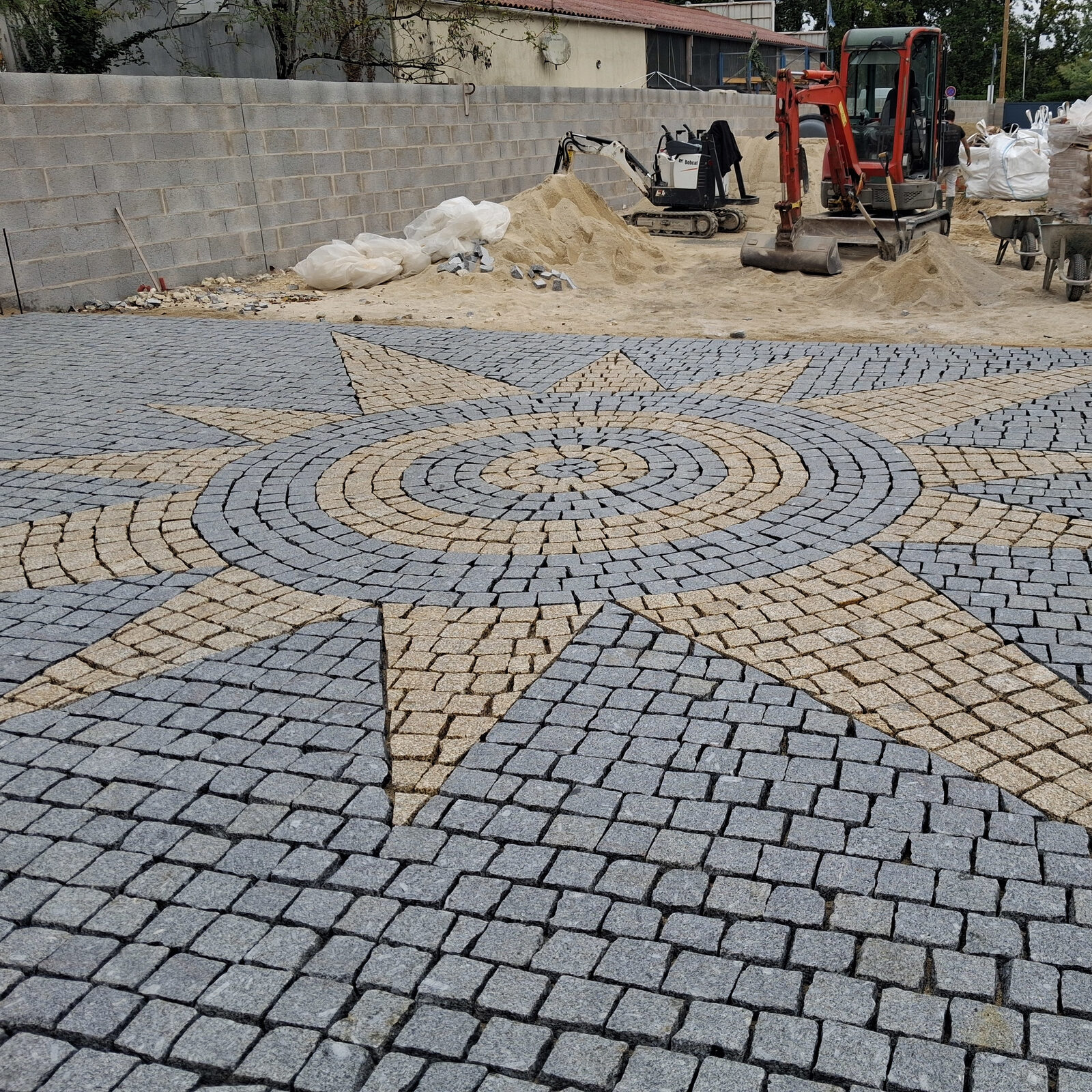
The rosette pattern
Also called wind rose or rosette: the setts are arranged in a circle around a central point. It is a limited, circular pattern, perfect for creating a focal point in the heart of a courtyard or esplanade.
- Striking focal point: ideal for dressing a large courtyard or esplanade.
- The laying starts from the centre and extends following the layout, guided by a string line.
- Can include spokes or circles of contrasting colours.
- Often surrounded by an edging that enhances it.
Tip: the rosette combines with a straight or arch pattern around it to cover the rest of the surface.
The cross pattern
Also called the Portuguese cross or Celtic cross: setts of contrasting colours draw a cross. It is one of the most representative patterns of the Portuguese pavement (calçada portuguesa).
- A hallmark of Portuguese paving, rich in history and culture.
- Made with two colours: often a light background and a dark cross, or the reverse.
- Suits entrance thresholds, decorative paving and passage areas.
- Can be repeated to create a regular grid over the whole surface.
Advice: combine grey, black, yellow or pink granite setts for contrasted, harmonious crosses.


Custom patterns
The art of the Portuguese pavement allows almost anything to be drawn in setts: waves (the "Mar largo" pattern of Lisbon), compasses, wind roses, flowers, clovers, logos, friezes and geometric shapes.
- Patterns created on request, reproduced by experienced pavers.
- Optical play and contrast: squares, triangles, circles and waves by alternating shades.
- The wave pattern, created in Lisbon in 1848, became a symbol of Portuguese identity.
- Several patterns can be combined on the same surface depending on its shape.
Advice: send us your drawing or logo, we will work out the layout and the colours suited to your project.
Mortar bed or sand bed?
The choice of the laying bed depends on the use, the slope and the thickness of the setts.
Mortar bed
- Recommended for high-traffic areas (streets, car parks).
- Ideal on sloping surfaces.
- Mandatory for 5 cm thick setts.
- More stable and durable, but less permeable.
Sand bed
- Ideal for pedestrian paths, terraces and gardens.
- Permeable and easy to repair (lift a sett without breaking everything).
- Uses 10 cm thick setts.
- Resistant to heavy loads.
The steps for laying a granite pavement
- Ground preparation: excavate 15 to 25 cm, compact, lay a geotextile and a layer of gravel or sand for drainage.
- Laying bed: a 5 to 15 cm layer of sand or weak mortar to stabilise the setts (the bed is not compacted; the paver works into it).
- Retaining edging: lay the edge lines and buttresses (edgings or mortar haunches) that block the lateral movement of the setts.
- Laying the setts: align according to the layout, tap with a rubber mallet to the string-line height. Start from the top of the slope.
- Jointing: fill the joints with sand (dry laying), polymer sand, or mortar grout for poured joints.
- Final compaction: run the vibrating plate to stabilise the whole, then clean the surface.
Plan a minimum 2% slope to drain the water, use a draining laying bed (gravel + sand) and avoid mortar joints if permeability is crucial.
Discover our granite setts and granite slabs from Portugal to create these laying patterns, as well as the different granite finishes.
We quote your project at the fairest price
Describe your project in a few lines. We respond quickly with a detailed quote.
A question? Call or write to us, we respond quickly.